

Synthetic Filaments
Synthetic filaments are today a key component in the production of paintbrushes, industrial brushes, brooms and toothbrushes. The brush industry has evolved rapidly: since around 2013, the availability of natural bristles has decreased and prices — especially for long lengths — have risen significantly. This has accelerated the development of increasingly high‑performance synthetic alternatives.
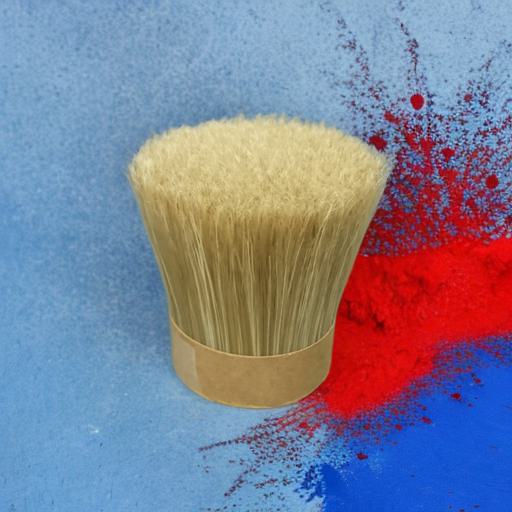
Listening to the needs of our customers, we continue to develop filaments that consistently improve the performance of professional brushes. The image on the side shows the result of one of our studies: a 100% synthetic filament, mechanically tapered, feathered, and capable of reproducing the main characteristics of natural bristle.
The development of new filaments for paintbrushes — and many other applications — has become essential to ensure quality, precision and long‑lasting performance.
Thanks to our experience, we can supply solutions for the production of high‑quality brushes, using either pure synthetic filaments or blends that include natural bristles.
Advantages and Disadvantages of Synthetic Filaments
Advantages
- Excellent recovery strength and elasticity from bending or twisting.
- Controlled taper ratio (short, medium, long).
- More affordable than comparable natural hair.
- Durable and less prone to breakage on various surfaces.
- Easy to clean.
Disadvantages
- Points are not as fine as high‑quality sable or squirrel hair brushes.
- Filaments absorb but release liquid paints and inks too quickly.
- Excess resilience (“snap”) reduces control of brush strokes.
- Very smooth surface makes pick‑up and spreading of thick paint more difficult.
Types of Synthetic Filaments
Cylindrical Filaments (PET)
- Available in different colours and diameters.
- Possibility to create blends with natural bristles.
- Suitable for brushes, brooms and general applications.
Mechanically Tapered Filaments
- Natural taper from base to tip, without chemical treatments.
- Mechanical tipping for softness and delicate finishing.
- Prevent streaking and improve paint flow.
- The most advanced solution for imitating natural bristle.
Chemically Tipped Filaments
- Cylindrical filaments tipped only at the end through a chemical process.
- Available solid or with a micro‑hollow core for reduced weight.
- Cost‑effective solution for medium‑quality brushes.
Sections and Blends
The filaments listed above can be produced with different cross‑sections and mixed together to achieve performance superior to natural bristle in terms of:
- Elasticity
- Softness
- Product‑holding capacity
- Wear resistance
Main Applications
- Paintbrushes
- Toothbrushes
- Industrial brushes
- Food‑processing brushes
- Road‑sweeping machine brushes
- Vacuum‑cleaner brushes
High‑Precision Japanese Filaments
We also supply a Japanese‑made filament, highly appreciated for its exceptional softness at the tip, ideal for:
- Cosmetic brushes
- Fine art brushes
- Applications where the finest natural hairs are normally used
Available in the standard length of 51 mm and in diameters 0.07 – 0.10 – 0.15 mm.
Technical Specifications of Synthetic Filaments
Our synthetic filaments are produced by leading manufacturers such as Toray, Teijin, Konex, SYK, Krex and Yasuda. They are made of P.B.T. (Poly‑Butyle Telephthalate), a polymer suitable for both watercolours and oils, and particularly effective for acrylic paints.
Available dimensions
- Diameters: 0.07 / 0.10 / 0.14 / 0.15 / 0.20 mm
- Lengths: 35 – 70 mm
Standard colours
- White
- Golden brown
- Dark brown
- Red brown
Also available in two‑tone or three‑tone versions, straight or crimped, with shiny or matte finish.
Information on Main Polyamides
Nylon 6
- Excellent abrasion resistance and chemical resistance.
- Outstanding elastic recovery.
- Resistant to saline and alkaline solutions.
- The most economical polyamide.
- Used for brushes not intended for humid environments (e.g., clothes brushes).
Nylon 66
- Lower water absorption than Nylon 6.
- Higher elasticity.
- Used for hairbrushes and economical hygienic brushes.
Nylon 6,12
- Ideal for toothbrushes and cosmetic brushes.
- Allows very fine diameters (< 0.10 mm).
- High flexibility and heat resistance.
Polyester
- Hollow section, 30–40% lighter than solid synthetic fibres.
- Used for brooms and general‑purpose brushes.
Polypropylene (PPN)
- Easy to process, excellent chemical resistance.
- Low density, high stiffness, good abrasion and heat resistance.
- Available in:
- Type N: household brushes, paintbrushes, vacuum‑cleaner brushes.
- Type H: super‑stabilised, for applications requiring high resistance and flexibility.
Filaments for Toothbrushes
For high‑quality toothbrushes, Nylon 612 is mainly used. For medium‑quality toothbrushes, Nylon 66 is preferred.
In rare cases, bleached natural bristle is still used. For particularly soft toothbrushes, badger hair may be requested.