


The strengthening of the yuan against the dollar can affect the prices of raw materials purchased from China. Let's look at how the USD/RMB exchange rate changed from 2023 to 2026 and what this may mean for buyers of natural bristles, horsehair and synthetic filaments.
Why the USD/RMB exchange rate affects raw material prices
Many raw materials used in brush and paintbrush manufacturing purchased from China are quoted and sold in US dollars (USD).
Chinese manufacturers, however, incur a large proportion of their costs in yuan (RMB): labour, processing, energy, domestic transport and other production costs.
When the dollar weakens against the yuan, the manufacturer receives fewer RMB for the same price expressed in USD.
This can reduce margins and, if the exchange-rate movement persists, create upward pressure on selling prices.
USD/RMB exchange rate trends from 2023 to 2026
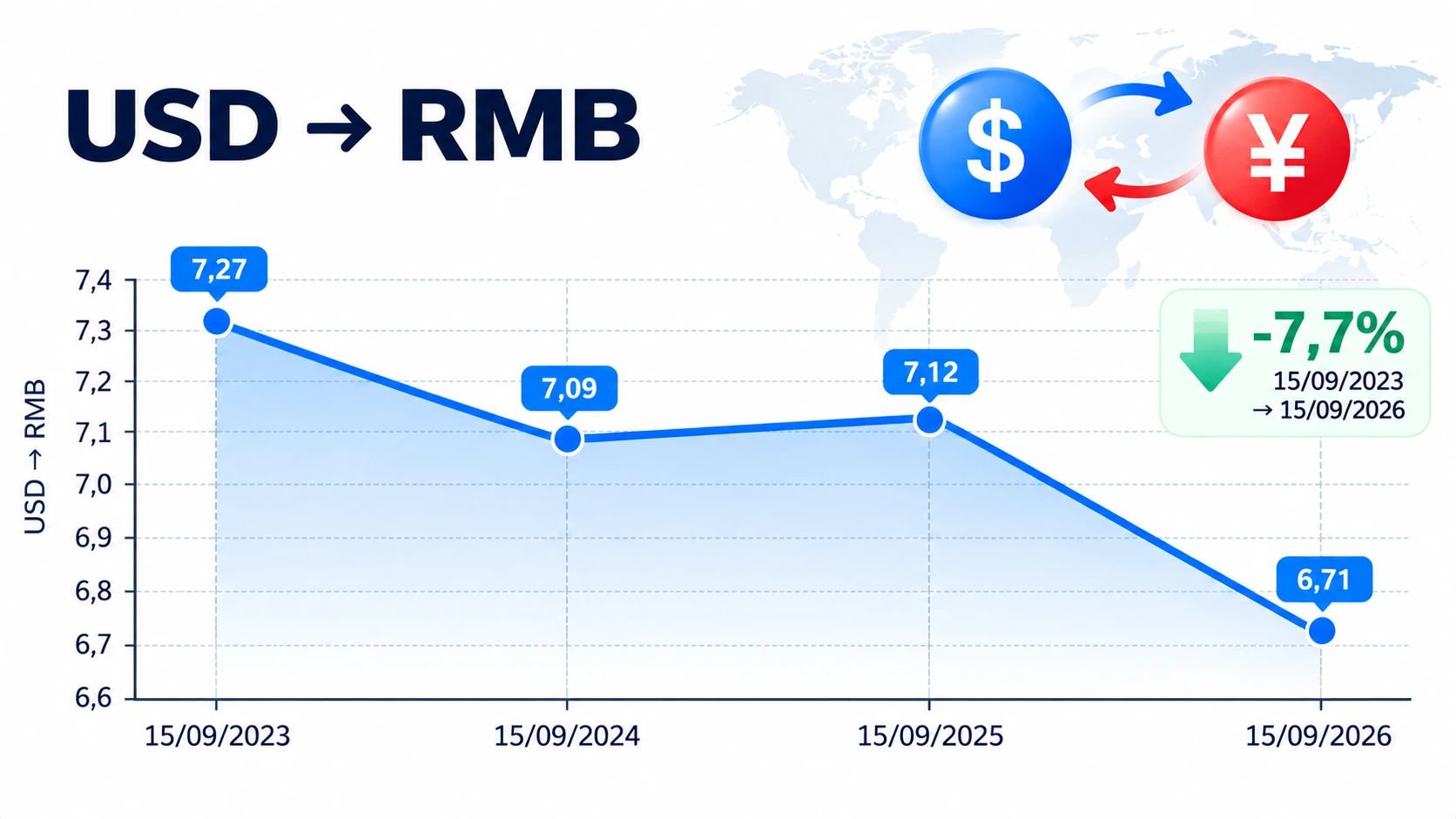
To compare the exchange rate over time, we use 15 September of each year as the reference date. The USD/CNY exchange rates, where CNY is the currency code for the renminbi (RMB), show the following trend:
| Date | 1 USD equals |
|---|---|
| 15 September 2023 | 7.2748 RMB |
| 15 September 2024 | 7.0937 RMB |
| 15 September 2025 | 7.1190 RMB |
| 15 September 2026 | 6.7116 RMB |
Between 15 September 2023 and 15 September 2026, the amount of RMB obtained for one dollar therefore decreased by approximately 7.7%.
What does this mean in practical terms for a Chinese manufacturer?
Let's take a simple example. Suppose a Chinese manufacturer sells a particular material while keeping the price unchanged at 100 USD.
The equivalent value in RMB changes as follows:
| Year | Value of 100 USD |
|---|---|
| 2023 | approximately 727 RMB |
| 2024 | approximately 709 RMB |
| 2025 | approximately 712 RMB |
| 2026 | approximately 671 RMB |
In 2026, at the same dollar price, the RMB equivalent of 100 USD is therefore approximately 56 RMB lower than in 2023.
The difference represents a reduction of approximately 7.7% in the value expressed in local currency.
If costs incurred in China remain unchanged or increase over the same period, this exchange-rate movement can place additional pressure on the manufacturer's margins.
How can manufacturers respond to reduced margins?
Not all companies respond in the same way. Several strategies are possible.
1. Temporarily absorb the exchange-rate movement
A well-structured company with sufficient margins may decide to keep its USD prices unchanged, temporarily absorbing the effect of the currency movement.
This may be possible in the short term, but can become progressively more difficult to sustain if the USD/RMB exchange rate remains unfavourable.
2. Adjust prices in US dollars
Another option is to increase the price expressed in USD to compensate, at least in part, for the lower amount received in RMB.
For this reason, exchange-rate movements can contribute to changes in the prices of raw materials purchased from China.
3. Reduce production costs
The manufacturer may also try to recover margins through greater production efficiency or cost reductions.
For some raw materials, however, strong pressure on costs can make it more difficult to maintain the same material selection, supply characteristics and quality-control standards.
For buyers, it therefore becomes important to check not only the price, but also whether the agreed characteristics remain consistent over time.
Why exchange rates matter when purchasing quality materials
In the professional brush and paintbrush industry, the price of the raw material is only one of the factors to consider.
Natural bristles, horsehair, fine hairs and synthetic filaments intended for quality manufacturing require, depending on the material and application:
- careful selection;
- defined technical characteristics;
- consistent supplies;
- quality controls;
- consistency over time.
When price pressure becomes significant, maintaining these characteristics can become more difficult.
For this reason, a price difference between two supplies should be evaluated together with the technical specifications and consistent quality of the material.
Does a low price mean lower quality?
Not necessarily.
A manufacturer may be more efficient, have a different cost structure or decide to temporarily reduce its commercial margin.
Similarly, a higher price does not automatically guarantee higher quality.
However, when a quotation differs significantly from general market conditions, it is advisable to check carefully what is being purchased: material characteristics, selection, tolerances, uniformity and continuity of supply.
For a brush or paintbrush manufacturer, the true cost of a raw material depends not only on its purchase price, but also on its reliability in the manufacturing process and the consistency of the finished product.
USD/RMB exchange rate: what to consider when purchasing from China
Between 15 September 2023 and 15 September 2026, the USD/CNY exchange rate moved from approximately 7.27 to 6.71 RMB per dollar, representing a decrease of approximately 7.7% in the yuan value of one dollar.
For a Chinese manufacturer that sells in USD but incurs a large proportion of its costs in RMB, this means receiving a lower amount in local currency for the same price expressed in dollars.
The USD/RMB exchange rate is therefore one of the factors to consider when analysing changes in the prices of raw materials sourced from China, together with raw material, energy, labour and logistics costs, as well as demand conditions.
For companies purchasing materials for professional brush and paintbrush manufacturing, understanding these mechanisms makes it possible to evaluate a supply more comprehensively: not only in terms of price, but also in terms of quality, consistency and long-term reliability.
Data note: USD/CNY exchange rates refer to 15 September of each year. As 15 September 2024 fell on a Sunday, the available historical value reflects the quotation reported for that date. Figures in the text and chart have been rounded for ease of reading.