


In professional paintbrush engineering, increasing fibre stiffness generally improves paint transfer and brush control during application. However, the real technical challenge lies in simultaneously enhancing finish quality and surface protection—two critical parameters that tend to diminish when fibre stiffness is increased.
The DT HyperStiff continuously tapered synthetic filaments developed by Nexstar are specifically engineered to eliminate this trade-off, providing paintbrush manufacturers with a solution that combines superior stiffness, coating build, and real productivity.
The Evolution of Modern Coatings
Paints and coatings are shear-thinning fluids: their apparent viscosity decreases as the application shear rate increases during brush application.
In the 1960s, paint viscosity typically ranged between 500 and 1,000 cPs. Today, driven by stringent VOC (Volatile Organic Compounds) reduction regulations and enhanced performance demands, viscosities regularly reach 700 to well over 3,500 cPs.
With such dense formulations, paintbrushes are frequently evaluated by how far they can drag paint in a single stroke. To meet this demand, the industry's default response has been to increase fibre stiffness; however, a longer stroke alone does not automatically equate to higher productivity.
The Limitations of Chemically Tipped Fibres
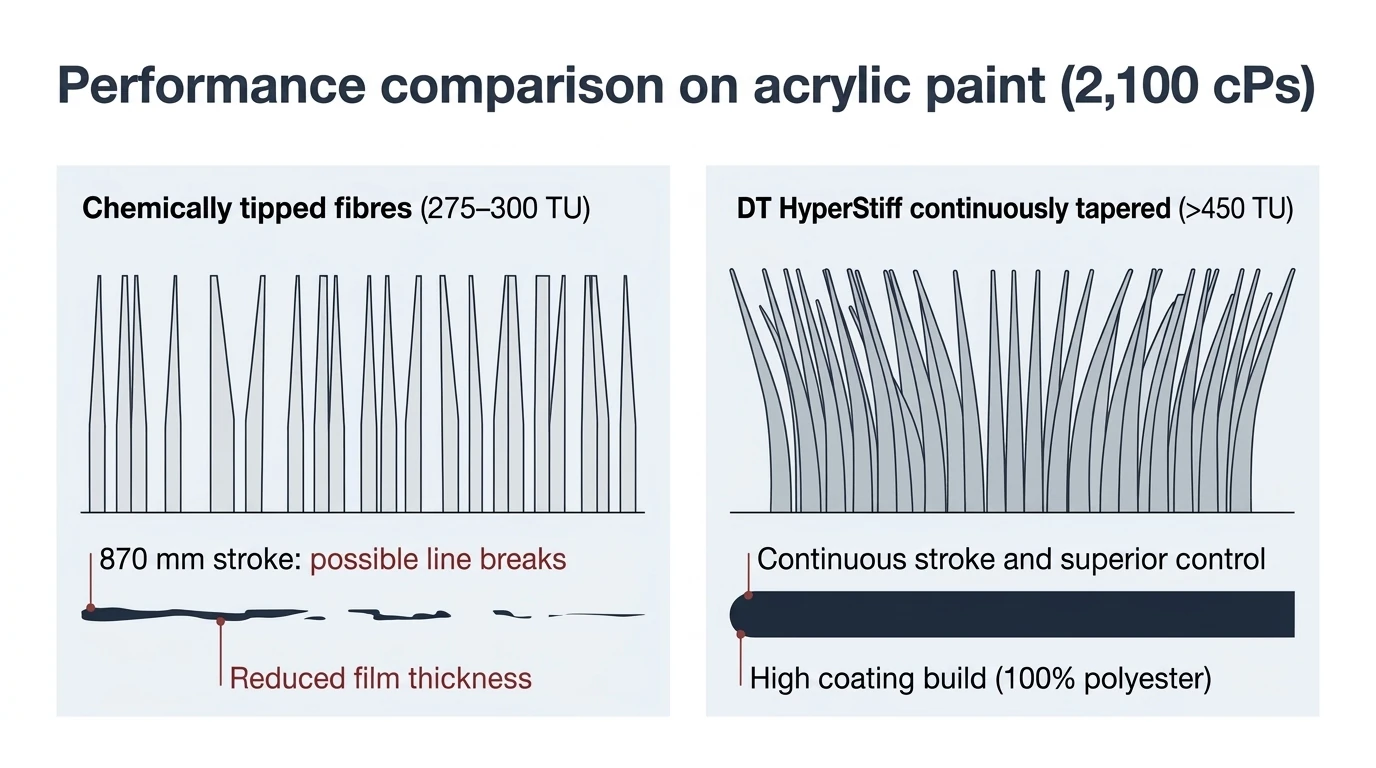
In conventional straight, chemically tipped synthetic fibres, a high filament count delivers finer paint metering, resulting in longer stroke lengths at the expense of a lower coating film thickness.
To increase stiffness in these fibres, filament diameter must be enlarged. This inevitably reduces the total filament count in the brush head, compromising overall brush performance and finish consistency.
Even market-leading ultra-stiff brushes in this category (rated at 275–300 TU stiffness) fail to complete a continuous 870 mm robotised stroke using premium 2,100 cPs acrylic paint without experiencing line breaks.
Overcoming the Trade-off with Continuously Tapered Filaments
Continuously tapered fibres operate under the opposite mechanism: a lower filament count enables richer paint metering, resulting in slightly shorter stroke lengths but significantly higher coating film thickness.
Historically, the industry compensated for lower paint transfer by adopting Nylon and Polyester blends. While premier ultra-stiff blends (250–275 TU) perform well with 2,100 cPs acrylic paints, nylon remains an expensive raw material.
Nexstar DT HyperStiff technology transcends this limitation by delivering exceptional stiffness exceeding 450 TU for uncompromising brush control, combined with competitive stroke length, rich coating build, and the cost efficiency of an all-polyester fibre solution.
Real Productivity in Professional Application
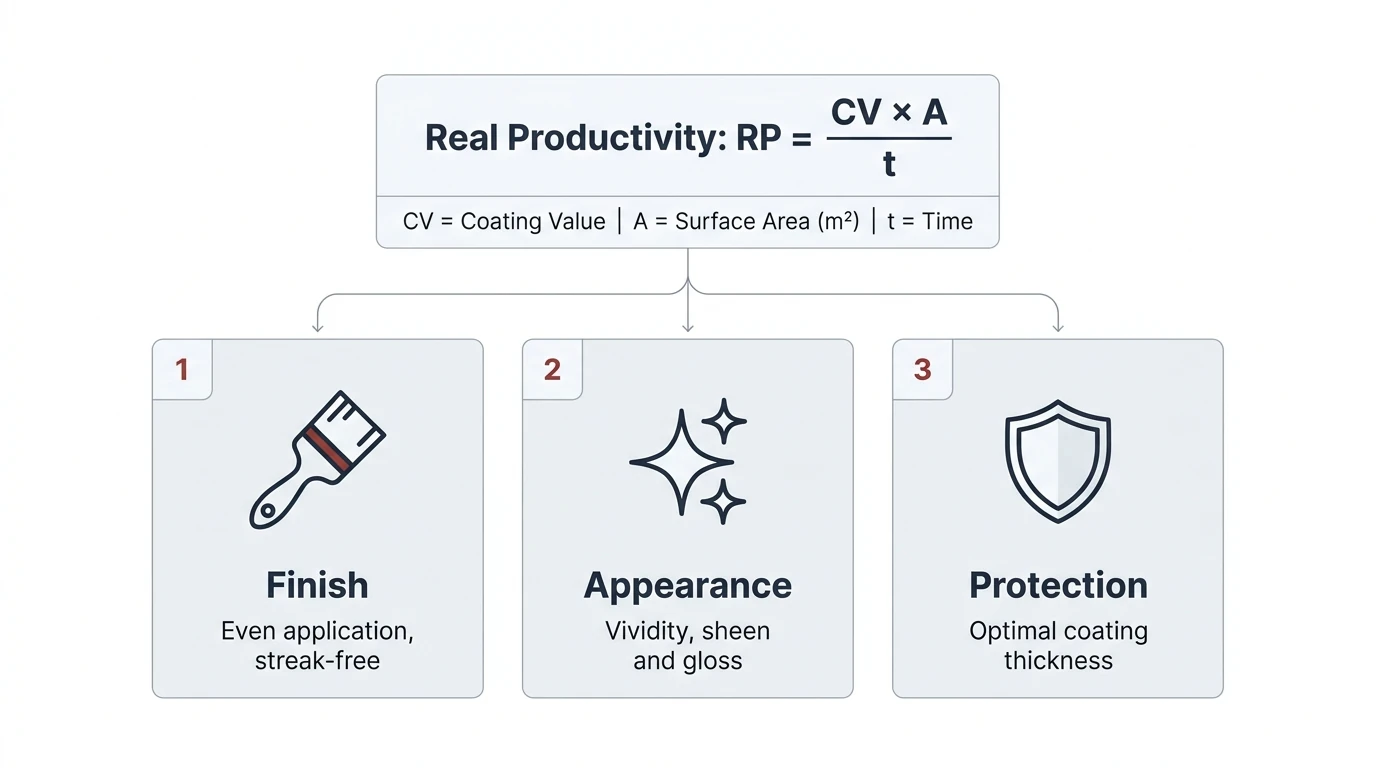
To accurately assess the efficiency of a professional paintbrush, measuring stroke length alone is insufficient. Efficiency must be evaluated through Real Productivity (RP), defined by the formula RP = (CV × A) / t, where A represents the coated surface area (in m²) and t is the application time.
The Coating Value (CV) synthesises the overall quality of the applied coating, combining finish quality (smooth, streak-free application), paint appearance (colour vividness, gloss, and sheen), and surface protection (adequate coating thickness).
In this context, Nexstar DT HyperStiff fibres redefine productivity benchmarks by delivering superior brush control and higher coating value in less time.
Technical Documentation
The Nexstar technical document “Stiffness-Finish Conundrum” provides in-depth data on filament stiffness, paint rheology, brush control, coating build, and real application productivity with DT HyperStiff technology.